Tag: 169 tech tips

Tech Tip #168: Software vs. Online Tools
 In these 169 tech-centric situations, you get an overview of pedagogy—the tech topics most important to your teaching—as well as practical strategies to address most classroom tech situations, how to scaffold these to learning, and where they provide the subtext to daily tech-infused education.
Today’s tip: Software vs. Online Tools
Category: Pedagogy
Here are relevant criteria for evaluating software vs. online tools in your classroom:
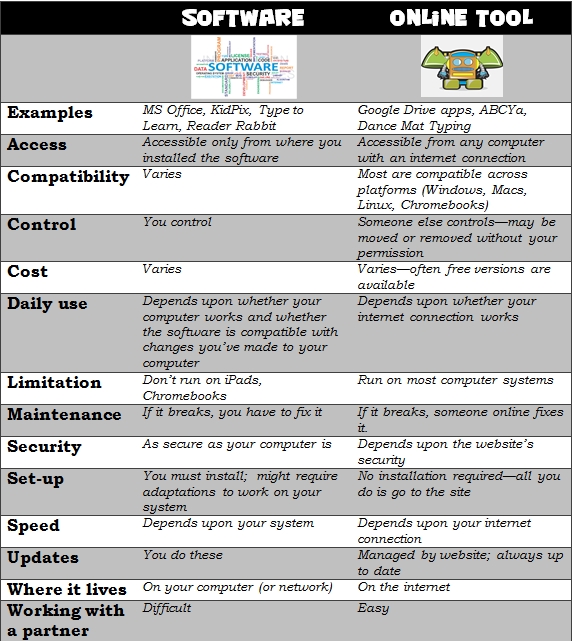
For more detail on comparing software and online tools, visit “8 Reasons For and 8 Against Revisiting Software in Your Classroom” on Ask a Tech Teacher.
Sign up for a new tip each week or buy the entire 169 Real-world Ways to Put Tech into Your Classroom.
What’s your favorite tech tip in your classroom? Share it in the comments below.

Tech Tip #29 I can’t find a file
In these 169 tech-centric situations, you get an overview of pedagogy—the tech topics most important to your teaching—as well as practical strategies to address most classroom tech situations, how to scaffold these to learning, and where they provide the subtext to daily tech-infused education.
Today’s tip: Find a file
Category: Problem-solving
Q: I saved my document, but I can’t find it. What do I do?
A: There are five ways to search for a document you saved, but don’t remember where (see poster below):
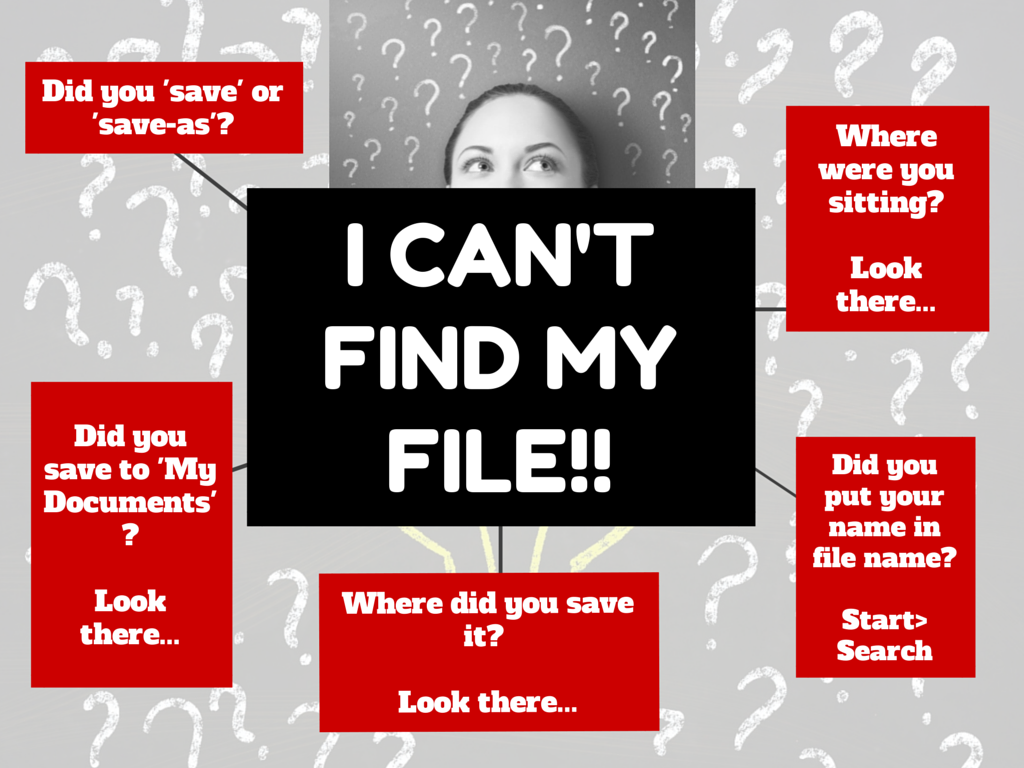
If none of these work, try these two:
- One: Open the program you created it in, say MS Word.
- Select File>Open. MS Office programs–Word, Publisher, Excel, PowerPoint–and some other software show recently created documents in the task panel. Check to see if your document shows up there. If so, open it and re-save it in a spot you’ll remember.
- Two: Not there? Click the Start Button. Type the file name in Search. This will Search only locations attached to your computer. For example, it won’t find files on your flash drive if it isn’t plugged in or an external folder.
Sign up for a new tip each week or buy the entire 169 Real-world Ways to Put Tech into Your Classroom.
What’s your favorite tech tip in your classroom? Share it in the comments below.
Tech Tip #45 My Screen is Sideways!!
In these 169 tech-centric situations, you get an overview of pedagogy—the tech topics most important to your teaching—as well as practical strategies to address most classroom tech situations, how to scaffold these to learning, and where they provide the subtext to daily tech-infused education.
Today’s tip: How to fix a tilted screen
Category: Problem-solving
Q: My screen is sideways 90 degrees. How do I fix that?
A: If you ever needed this, you’re going to bless me. I run a tech lab and there are always those pesky prodigies who want to outsmart me. They know if they push Ctrl+Alt+(down arrow), it’ll turn the screen upside down. The first time it happened, I was at a loss. That’s when a different pesky prodigy told me how to fix it:
Ctrl+Alt+(up arrow)
If you use Chromebooks, the following keyboard shortcut will rotate the screen 90 degrees:
Ctrl + Shift and Reload
Note: the keys must be pressed simultaneously.
Sign up for a new tip each week or buy the entire 169 Real-world Ways to Put Tech into Your Classroom.
What’s your favorite tech tip in your classroom? Share it in the comments below.
Tech Tip #55 Find a Lost Shortcut
In these 169 tech-centric situations, you get an overview of pedagogy—the tech topics most important to your teaching—as well as practical strategies to address most classroom tech situations, how to scaffold these to learning, and where they provide the subtext to daily tech-infused education.
Today’s tip: How to find a lots shortcut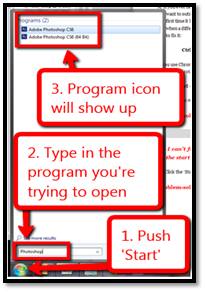
Category: Problem-solving
Q: I can’t find the shortcut for a program I want to open. It’s not on the desktop, the start menu or in ‘all programs’. How do I open the program?
A: PC’s: Click the ‘Start button’, then type the program name where it says ‘search’ to get the shortcut.
iPads: Swipe down from the top with one finger and type the program name in the search bar.
For Chromebooks: Look in Apps or on the Chromebook Shelf at the bottom of the device. Or, use Alt+Shift+M to open the File Manager.
Sign up for a new tip each week or buy the entire 169 Real-world Ways to Put Tech into Your Classroom.
What’s your favorite tech tip in your classroom? Share it in the comments below.
Tech Tip #35 My Program Closed Down
In these 169 tech-centric situations, you get an overview of pedagogy—the tech topics most important to your teaching—as well as practical strategies to address most classroom tech situations, how to scaffold these to learning, and where they provide the subtext to daily tech-infused education.
Today’s tip: My program closed down
Category: Problem-solving
Q: I was working on my program and it disappeared. Did I lose my work?
A: Before you arrive at that conclusion, try these two steps:
- Check the taskbar. If your program is blinking at you, click to maximize. For some reason, it fell asleep.
- If the program closed, re-open. MS Office: A panel on the left of the re-opened program prompts you to select the auto-saved doc. The program automatically saves every two to ten minutes. You’ve lost some of your work, but not much.
From now on, save early, save often. Every ten minutes.
Sign up for a new tip each week or buy the entire 169 Real-world Ways to Put Tech into Your Classroom.
What’s your favorite tech tip in your classroom? Share it in the comments below.

Tech Tip #182: Easy Speech-to-Text–and Free
 Tech Tips for Writers is an occasional post on overcoming Tech Dread among teacher-authors. I’ll cover issues that writer friends, both real-time and virtual, have shared. Feel free to post a comment about a question you have. I’ll cover it in a future tip.
You may have seen this on my education blog
A friend posted about needing suggestions for speech-to-text options for his writing. It reminded me that some people may not know that this tool is now built into both Google Docs and MS Word (for those with Office 365 only). Make sure your microphone is enabled and then here’s how to use them:
MS Word
- Open a Word doc
- Go to Home>Dictate
Google Docs
- Be sure you are in Chrome
- Open Google Docs (easiest way: type doc.new into your Chrome browser for a new file)
- Go to Tools>Voice typing
That’s it! Questions? Ask them in the comments
Copyright © 2023 AskaTechTeacher.com – All rights reserved.

Here’s the sign-up link if the image above doesn’t work:
Jacqui Murray has been teaching K-18 technology for 30 years. She is the editor/author of over a hundred tech ed resources including a K-12 technology curriculum, K-8 keyboard curriculum, K-8 Digital Citizenship curriculum. She is an adjunct professor in tech ed, Master Teacher, webmaster for four blogs, an Amazon Vine Voice, CSTA presentation reviewer, freelance journalist on tech ed topics, and author of the tech thrillers, To Hunt a Sub and Twenty-four Days. You can find her resources at Structured Learning.
Tech Tip #38 My desktop icons changed
In these 169 tech-centric situations, you get an overview of pedagogy—the tech topics most important to your teaching—as well as practical strategies to address most classroom tech situations, how to scaffold these to learning, and where they provide the subtext to daily tech-infused education.
Today’s tip: My desktop icons changed
Category: Problem-solving
Q: The desktop icons I usually have are gone and some I’ve never seen before are there. What happened?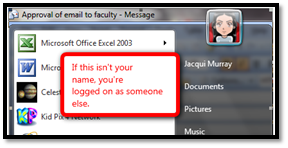
A: I get this question a lot: Push the start button (on your PC) and check the login. It should be your log-in name. Any other, log out and in as yourself.
The difference on a Chromebook shows up on the Shelf; an iPad, on the Home screen. Make sure you’re the active profile.
This happens often when each grade level has a separate log-in. Students being students often forget to log out. I teach even the youngers how to solve this problem. Truth be known, lots of teachers have this problem, also. They’re used to sitting down at a computer shared only with themselves. If the tech geeks do something on it–maybe fix a problem–and forget to log out, my teachers are lost.
Sign up for a new tip each week or buy the entire 169 Real-world Ways to Put Tech into Your Classroom.
What’s your favorite tech tip in your classroom? Share it in the comments below. (more…)
Tech Tip #23 I Deleted a File by Accident
In these 169 tech-centric situations, you get an overview of pedagogy—the tech topics most important to your teaching—as well as practical strategies to address most classroom tech situations, how to scaffold these to learning, and where they provide the subtext to daily tech-infused education.
Today’s tip: I deleted a file by accident.
Category: Problem-solving
- Here’s what you do:
- find the recycle bin (in PCs, it’s on your desktop; in Google Drive, it’s called ‘Trash’)
- open (in PCs, right click; in Google Drive: simply click to open)
- find your file; select ‘restore’
‘Restoring’ sends it back where it was before you deleted it.
If you deleted it from a flash drive, it’s gone. There are programs for undeleting from external drives, but they cost money and are more complicated than this ebook allows.
Sign up for a new tip each week or buy the entire 169 Real-world Ways to Put Tech into Your Classroom.
What’s your favorite tech tip in your classroom? Share it in the comments below.

Tech Tip #169: What is Digital Literacy?
In these 169 tech-centric situations, you get an overview of pedagogy—the tech topics most important to your teaching—as well as practical strategies to address most classroom tech situations, how to scaffold these to learning, and where they provide the subtext to daily tech-infused education.
Today’s tip: What is Digital Literacy?
Category: Pedagogy
‘Digital literacy’ is one of those buzz words floated by experts as being granular to 21st-century students. It’s everywhere, on everyone’s tongue, but figuring out what it means can be daunting. ‘Literacy’ is simple: the ability to read and write–so ‘digital literacy’ should be achieving those goals digitally.
Sounds simple. The difficult is in the implementation. Here are the sixteen transformative tools, activities, and/or knowledge bases digitally-literate students should be comfortable using:
- annotation tool
- backchannel device
- class internet start page
- class website or blog
- cloud computing
- digital citizenship
- digital class calendar
- digital databases
- digital devices–such as laptops, iPads, Chromebooks, or desktops, for daily use
- online information
- sharing digitally to build knowledge
- social media
- student digital portfolios–to curate and collect work
- email–or another method of communicating quickly outside classtime (such as messaging or Twitter)
- virtual collaboration
- vocabulary tool–to quickly decode words students don’t understand
For more detail on the tools, activities, and knowledge bases above—as well as the general topic of digital literacy—visit “Digital Literacy—What is it?” on Ask a Tech Teacher.
More on Digital Literacy:
- How to Assess Digital Literacy
- Digital Literacy in Busy Classrooms
- Digital Literacy–Too Important to Skip
Sign up for a new tip each week or buy the entire 169 Real-world Ways to Put Tech into Your Classroom.
What’s your favorite tech tip in your classroom? Share it in the comments below.
Copyright ©2022 worddreams.wordpress.com – All rights reserved.
Tech Tip #167–How to Evaluate Apps
In these 169 tech-centric situations, you get an overview of pedagogy—the tech topics most important to your teaching—as well as practical strategies to address most classroom tech situations, how to scaffold these to learning, and where they provide the subtext to daily tech-infused education.
Today’s tip: How to Evaluate Apps
Category: Pedagogy
Here are thirteen tips to evaluate the apps you’ll find useful in your classroom:
- free or small fee
- stand the test of time
- positive parent reports
- rated ‘for everyone’ or ‘low maturity’
- no in-app purchases or billing
- support the ‘4 C’s’–creativity, critical thinking, communication, collaboration
- offer compelling content (this is subjective: ‘Compelling’ varies teacher-to-teacher and student-to-student)
- are not distracting or overwhelming in colors, music, or activity
- offer levels that become increasingly more difficult, providing differentiation for student needs
- few ads–and those that are there do not take up a significant portion of the screen
- intuitive to use with a shallow learning curve that encourages independence
- easily applied to a variety of educational environments
- doesn’t collect personal information other than user credentials or data required to operate the app
Sign up for a new tip each week or buy the entire 169 Real-world Ways to Put Tech into Your Classroom.
What’s your favorite tech tip in your classroom? Share it in the comments below.
Copyright ©2022 askatechteacher.com – All rights reserved.