Tag: 169 tech tips

Tech Tip #135: 5 Tips on Internet Research

In these 169 tech-centric situations, you get an overview of pedagogy—the tech topics most important to your teaching—as well as practical strategies to address most classroom tech situations, how to scaffold these to learning, and where they provide the subtext to daily tech-infused education.
Today’s tip:
Category: Parents
Here’s a poster with five tips that will help students as they use the internet for research:

Review these with students when they’re ready for each tip. By the end of fifth grade, they should be well-versed in all five of these.
Sign up for a new tip each week or buy the entire 169 Real-world Ways to Put Tech into Your Classroom.
What’s your favorite tech tip in your classroom? Share it in the comments below.
Tech Tip #64 Google Street View
In these 169 tech-centric situations, you get an overview of pedagogy—the tech topics most important to your teaching—as well as practical strategies to address most classroom tech situations, how to scaffold these to learning, and where they provide the subtext to daily tech-infused education.
Today’s tip: Google Street View
Category: Problem-solving
Q: I can’t find enough detail about a geographic area we’re studying. Any suggestions?
A: That’s much easier than it used to be, thanks to Google Earth’s Street View. Students can walk down the street they just read about or see their home on the internet.
Here’s how to use it:
- First, you must have Google Earth. It’s a free download and I’ve never had problems with the install. Take a minute to do that. I’ll wait. You can also use the online app–no need for a download.
- Done? Good. Now type the address into search; push enter.
- Zoom into an area until a pegman icon appears below the navigation controls on the right. Click and drag the icon to the area of interest, and then drop it onto the blue highlighted paths. That takes you to all the streets.
- Travel by double clicking on the street.
- To get out of it, click the button on the upper right.
Google Street View even covers hiking trails.
Google Earth works with PCs, Macs, iPads, and Chromebooks (with the app).
Sign up for a new tip each week or buy the entire 169 Real-world Ways to Put Tech into Your Classroom.
What’s your favorite tech tip in your classroom? Share it in the comments below.
Tech Tip #110 — Compare-contrast Digital Tools
In these 169 tech-centric situations, you get an overview of pedagogy—the tech topics most important to your teaching—as well as practical strategies to address most classroom tech situations, how to scaffold these to learning, and where they provide the subtext to daily tech-infused education.
Today’s tip: Compare-contrast Digital Tools
Category: Problem-solving
Have students use these tables to compare-contrast digital tools available for their education:
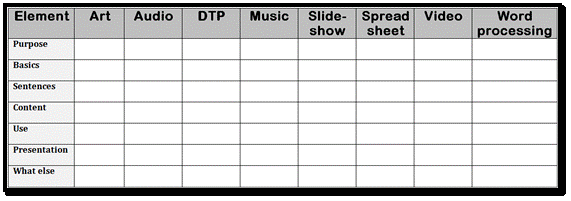
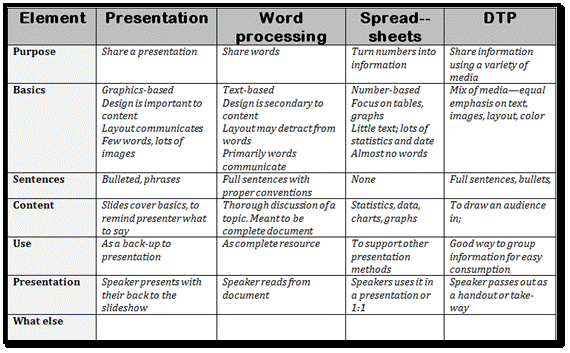
Set them up in your spreadsheet program and add only the labels. Show it on the class screen and have students suggest what data fills in the cells. If you have the Structured Learning Tech Curriculum, you’ll find copies of these in the ebook. Just have students fill them in digitally. If you have the print book, simply, print copies (you have permissions to reprint single pages when you purchase the book).
Sign up for a new tip each week or buy the entire 169 Real-world Ways to Put Tech into Your Classroom.
What’s your favorite tech tip in your classroom? Share it in the comments below.
Tech Tip #139: 9 Reasons to Use Digital Books
In these 169 tech-centric situations, you get an overview of pedagogy—the tech topics most important to your teaching—as well as practical strategies to address most classroom tech situations, how to scaffold these to learning, and where they provide the subtext to daily tech-infused education.
Today’s tip: Using digital books
Category: Problem-solving
As you discuss reading and the technology tools that inspire students in this activity, here’s a poster with nine reasons why students will love digital books:

They’re light-weight, easy to transport, provide links for deeper learning, differentiate for student needs (like zoom to see better or a change of font), allow for the addition of notes that can be erased, and pages never rip. What more could you ask?
Sign up for a new tip each week below or buy the entire 169 Real-world Ways to Put Tech into Your Classroom.
What’s your favorite tech tip in your classroom? Share it in the comments below.

Tech Tip #90: Don’t Be Afraid of Mulligans

As a working technology teacher, I get hundreds of questions from parents about their home computers, how to do stuff, how to solve problems. Each week, I’ll share one of those with you. They’re always brief and always focused. Enjoy!
Q: Some kids are hard workers, but they just don’t get computers. Their effort deserves a good grade, but their product is nowhere near class requirements. What can I do?

A: Don’t be afraid to give students a Mulligan–a do-over for you non-golfers. Some students don’t perform well under the pressure of a deadline. Some are so sure they’re no good at technology, that becomes their reality. Offer students a second chance if they’ll work with you after school. I have had countless students take advantage of this and come out after a few of those sessions strong and confident in class. All they had to see was that they could do it. Maybe some simple phrasing confused them and you can clear that up. Maybe the noise of a full class distracted them. Whatever it is, if you can show them how to find alternatives, solve their problems, they can apply that to technology class and other classes.
Most of the students I help 1:1 only need a few projects and then I never see them again for help. In fact, their confidence is so improved, they often are the kids who come in during lunch to offer assistance to other struggling students. (more…)

Tech Tip #5: Where Did the Taskbar Go?
 In these 169 tech-centric situations, you get an overview of pedagogy—the tech topics most important to your teaching—as well as practical strategies to address most classroom tech situations, how to scaffold these to learning, and where they provide the subtext to daily tech-infused education.
Today’s tip: Where Did the Taskbar Go?
Category: PC, Keyboarding
Q: Some programs hide the taskbar when they open. How do I access the Start button when that happens?
A: Push the flying windows (between Ctrl and Alt) to bring up the Start button.
It might have disappeared because it’s set to Autohide. Here’s how to fix that:
- Hover over the area where the taskbar lives.
- If it appears, right click on it and select Properties. Go to the Taskbar tab.
- Make sure the box that says Autohide isn’t checked.
If the taskbar doesn’t appear, hover over the extreme bottom edge of the screen. If a double-headed arrow appears, click and drag up to bring your toolbar back from the edge.
Sign up for a new tip each week or buy the entire 169 Real-world Ways to Put Tech into Your Classroom.
What’s your favorite tech tip in your classroom? Share it in the comments below.

Tech Tip #165 My Program Disappeared
Today’s tip: Find a lost program
Category: Problem-solving
If a program disappears, here are two quick ways to find it more than half the time (on PCs):
- Look around the screen
- Check the taskbar
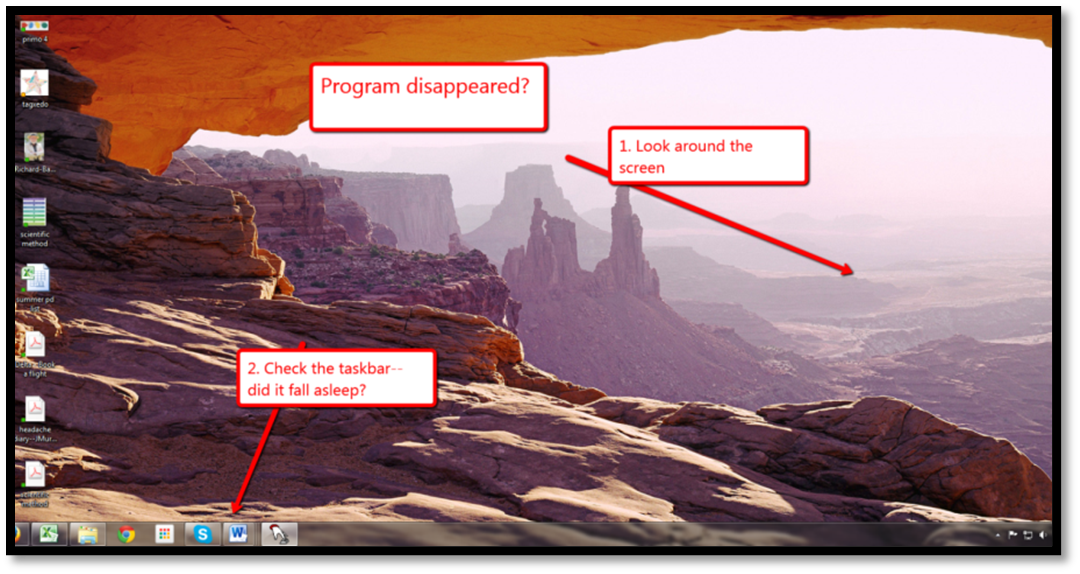
Sign up for a new tip each week or buy the entire 169 Real-world Ways to Put Tech into Your Classroom.
What’s your favorite tech tip in your classroom? Share it in the comments below.
Tech Tip #25: My Keyboard Doesn’t Work
As a working technology teacher, I get hundreds of questions from parents about their home computers, how to do stuff, how to solve problems. Each Tuesday, I’ll share one of those with you. They’re always brief and always focused. Enjoy!
You sit down to type, start in on that long project with an imminent deadline, and nothing happens. The cursor blinks… and blinks… and blinks… but goes nowhere.
What do you do?
Before you buy a new keyboard, try a few things:
- Is the keyboard’s power light on? If it is, check your screen. Is there something that’s preventing you from typing? Maybe a dialogue box that wants an answer? If the light isn’t on, continue down this list
- Check the plugs. Maybe the cord that connects the keyboard to the computer is loose or fell out.
- Reboot. Sometimes the stuff in the computer’s boot-up sequence that makes the keyboard work gets lost. Restart your computer so it can re-establish itself.
- Do you eat at your keyboard? Does anyone? I say this next solution hesitantly: Bang on the key. Sometimes keys get food between them. If that doesn’t work, turn the keyboard over and see what falls out.
If none of those work, here are some pretty good suggestions from ChatGPT:
Tech Tip #41 Fix Computer with System Restore
In these 169 tech situations, you get practical strategies to address many classroom tech situations.
Today’s tip: Fix computer with system restore
Category: Problem-solving
Q: My computer no longer runs right. I downloaded the auto-updates to my PC and it hasn’t worked right since. What do I do?
System Restore is a recovery tool for Windows that allows you to reverse certain kinds of changes made to the operating system. One way to think of it is as an “undo” feature for the most important parts of Windows.
Here’s how you use it:
- Type ‘system restore’ into the search bar at the bottom of the start menu.
- Select ‘system restore’ from the list.
- Follow the directions.
Note: The system restores to a point you created earlier so you have to have done that. If you need help with this concept, here’s a longish YT that covers it in depth: (more…)
Tech Tip #67: How to Add Accents and more
As a working technology teacher, I get hundreds of questions from parents about their home computers, how to do stuff, how to solve problems. Each week, I’ll share one of those with you. They’re always brief and always focused. Enjoy!
Q: I teach Spanish and need a quick way to add accents to words. Can you help?
A: You can go through the symbols library, but there’s an easier way. Use the Ctrl key + the accent. Here is a table: