Author: Jacqui

We Honor July 4th in America

Like every year, I exuberantly celebrate America’s birthday. I’d say times are tough here in the US, but that seems to be true everywhere in the world. So, I won’t complain. I will enjoy the love of America as all of my international friends love their homeland.
[youtube https://www.youtube.com/watch?v=Ke4gRMowvQg]
Tech Ed Resources–K-12 Tech Curriculum
I get a lot of questions from readers about what tech ed resources I use in my classroom. I take time every summer to review them with you. Some are edited and/or written by members of the Ask a Tech Teacher crew. Others, by tech teachers who work with the same publisher I do. All of them, I’ve found, are well-suited to the task of scaling and differentiating tech skills for age groups, scaffolding learning year-to-year, offering inclusive solutions to the issue of tech tools–taking into account the perspectives of stakeholders, with appropriate metrics to ensure learning is organic and granular.
Today: K-12 Technology Curriculum
Overview
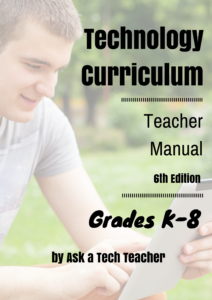
The K-12 Technology Curriculum is Common Core and ISTE aligned, and outlines what should be taught when so students have the necessary scaffolding to use tech for grade level state standards and school curriculum. You can purchase just the teacher manuals or student workbooks to serve a 1:1 environment, Google Classroom, and hybrid teaching situations.
Each grade-level PDF or print book (both are available) is between 175 and 252 pages and includes lesson plans, assessments, domain-specific vocabulary, problem-solving tips, Big Idea, Essential Question, options if primary tech tools not available, posters, reproducibles, samples, tips, enrichments, entry and exit tickets, and teacher preparation. Lessons build on each other kindergarten through 5th grade. Middle School and High School are designed for semester or quarter grading periods typical of those grade levels with topics like programming, robotics, writing an ebook, and community service with tech.
Most (all?) grade levels include keyboarding, digital citizenship, problem solving, digital tools for the classroom, and coding.
The curriculum is used worldwide by public and private schools and homeschoolers. (more…)

What’s Trending on Ask a Tech Teacher

I calculate what’s trending on my blog by which of my posts are popular in a particular time period. Here’s the run-down so far this year:
- 33 Great Research Websites for Kids
- K-12 Digital Tools
- How to Find Old Elementary School Teachers
- 100th Day of School — It’s about Learning
- Start Here (to use AATT)
- 17 Websites on Natural Disasters
- 14 Websites to Teach Mouse Skills
- How Students Can Build Their Own Apps
- Robot Teachers vs Human Teachers
- Want to Write for Us?
More top posts
Click here; scroll down the sidebar to “Top Posts”:


Tech Tips to End the School Year
Wrapping up your school technology for the summer is as complicated as setting it up in September. There are endless backups, shares, cleanings, changed settings, and vacation messages that — if not done right — can mean big problems when you return from summer vacation. If you have a school device, a lot of the shutdown steps will be done by the IT folks as they backup, clean, reformat, and maybe re-image your device. If you have a personal device assigned by the school but yours to take home, the steps may be more numerous but really, not more complicated.
Here’s a list. Skip those that don’t apply to you and complete the rest. I won’t take time in this article for a how-to on each activity so if you don’t know how to complete one, check with your IT folks or DDG (Duck Duck Go) or Google it:

What You Might Have Missed in May–What’s up in June

Most-read posts last month:
- May Is #Homeschool Awareness Month
- How do I grade technology in my school?
- National Personal Finance Challenge
- 5 Favorite Activities to End the School Year
- Successful USNA Graduates
- National Spelling Bee Coming In May
- Looking for Summer Activities? Try These
- Simple Ways Teachers Can Integrate AI Ethically in the Classroom

Here’s a preview of what’s coming up: (more…)

Looking for Summer Activities? Try These
Earlier, we posted books you might like to read this summer. Now, we’ll focus on what to accomplish with your summer. Here are popular AATT articles. Pick the ones that suit you:
How to Keep Learning Fresh Over the Summer
15 Skills To Learn this Summer and Use Next Year
6 Tech Activities for Your Summer School Program
12 Tech Tasks To End the School Year
Here’s How to Motivate Summer School Students
Seven Fun Math Activities for the Summer Break
How to Blend Learning with Play for a Kid-friendly Summer
6 Tech Activities for Your Summer School Program
15 Skills Teachers Can Learn this Summer and Use in Next Year’s Classroom
5 Apps to learn this summer

Happy Mother’s Day!

Mother’s Day in the United States is annually held on the second Sunday of May. This year, that’s May 11th. It celebrates motherhood and it is a time to appreciate mothers and mother figures. Many people give gifts, cards, flowers, candy, a meal in a restaurant or other treats to their mother and mother figures, including grandmothers, great-grandmothers, stepmothers, and foster mothers (click for updates to the list):.
- Mother’s Day activities
- Mother’s Day Activities from
- Mother’s Day cards
- Mother in different languages
- Mother’s Day Quotes
- Mother’s Day Sayings
- Mother’s Day Templates from Canva
Anyone have some favorite websites to share? My list isn’t terribly robust.
Enjoy your day with your children! (more…)
What You Might Have Missed in April–What’s up in May
Here are the most-read posts last month:
- Why School Counseling Is Essential in Modern Education Systems
- Subscriber Special: Discounted Curricula School License
- How Teachers and Parents Can Work Together to Support Student Well-Being
- April is Financial Literacy Month
- Tech Tips
- Earth Day Class Activities
- 8 Secrets for Getting into USNA (or a Service Academy)
- 4 Ways Students Can Plan Their Writing
Here’s a preview of what’s coming up: (more…)

May Is #Homeschool Awareness Month
Homeschool Awareness Month is celebrated in May and aims to demonstrate how homeschooling can be a better option than regular schooling for many kids and that they can have the same, if not better, growth while learning from home. Homeschooling Awareness Month wants to show parents how they too can be involved in the growth and learning of their children. This can actually help them become better parents while their kids enjoy a well-rounded upbringing and development. Parents want the best education for their children, and having a strong educational base is so important for children to be accepted for tertiary education or top-tier scholarships. (more…)

Earth Day Class Activities

Every year, the United Nations recognizes April 22nd as International Mother Earth Day. It is a day we all participate in making our air clean, water fresh and land unlittered rather than accepting the trash-filled oceans, the smoggy skies, and the debris-laden land that is becoming the norm.
Despite the questionable health of our world, we have made progress. Back in 1970, when Earth Day was first celebrated, trucks spewed black smoke as they drove down the highways, toxic waste was dumped into oceans with no repercussions, and the general opinion was that the Earth took care of itself. That changed when U.S. Senator Gaylord Nelson, Earth Day’s founder, witnessed the ravages of the 1969 massive oil spill in Santa Barbara California and decided it was time to do something. He started with a “national teach-in on the environment” with a simple goal: Encourage people to recognize the importance of protecting the Earth:
“It was on that day [Earth Day] that Americans made it clear they understood and were deeply concerned over the deterioration of our environment and the mindless dissipation of our resources.”