Year: 2026

10 Everyday Fun Moments That Teach Math Concepts Naturally

10 Everyday Fun Moments That Teach Math Concepts Naturally
Your child tells you math is boring, or pointless, or asks when they’ll ever use it. You know that’s wrong, but with a worksheet on the table it’s hard to say why.
Math is the one subject that never announces itself. Language is how your child talks to friends, history is stories, art is on the wall. Math just looks like symbols on a page.
It’s actually the most applicable subject they study. In a late 2025 Education Week survey, top executives said the skills young workers most lack are complex problem-solving, adaptability, and making sense of complex information. All of that is math.
You don’t have to teach it, just point at it. Below are 10 everyday moments, each with a question to ask and the answer to expect, pitched at elementary and early middle school and tagged 2–4 or 5–7. (more…)

Teacher-Authors: What’s Happening on my Writer’s Blog

A lot of teacher-authors read both my Ask a Tech Teacher education blog and my writer’s blog, WordDreams. In this monthly column, I share a popular post from the past month:

My last trilogy–Savage Land–dealt with a time 75,000 years ago when Neanderthals survived a natural disaster that should have wiped them off the planet. They found safe places around the planet, one of which was Gibraltar where Savage Land concentrates.
My next trilogy–In the Shadow of Giants–addresses their disappearance, when they became so few in number they could no longer sustain themselves as a species. Each book will deal with one way they attempted to cope with that inevitable end, when they were forced to find their future in the shadow of much more powerful human species. (more…)

How Technology Reshaped the Way Students Prepare for Language Exams
The proliferation of tech tools and digital devices has dramatically changed how students prepare for testing. The Ask a Tech Teacher team looked into this hot topic with a focus on language exams. Here’s an overview:

How Technology Reshaped the Way Students Prepare for Language Exams
Any teacher who prepared students for a language proficiency exam a decade ago remembers the routine: a textbook, a stack of photocopied practice papers, a cassette or CD for the listening section, and very little way of knowing how a student was actually doing until the results arrived. The materials were fine. The feedback loop was terrible. What has changed since then is less about the exams themselves, which remain fairly stable, and more about the tools available for getting a student ready and for knowing whether it is working. (more…)

What You Might Have Missed in July–What’s up in August

Here are the most-read posts last month:
- How Technology Is Transforming Language Learning for Students and Adults
- Subscriber Special: Free Hour of Code Bundle
- Tech Ed Resources–K-8 Keyboard Curriculum
- ISTE–Here’s how this hugely popular education conference went
- How to Choose (and Test) Tutoring Software Before You Buy
- Best Scratch Coding Classes for Kids: A Teacher’s Guide to the Top Programs
- USA Moon Landing July 20 1969
- Need a New Job? Update Your Resume
- How to Start Your Teaching Career: A Clear Guide to Becoming a Teacher
- How to Teach Middle School Students to Spot Deepfakes

Here’s a preview of what’s coming up: (more…)

Subscriber Special: Discount on Teacher Survival Kits

Every month, subscribers to our newsletter get a free/discounted resource to help their tech teaching.
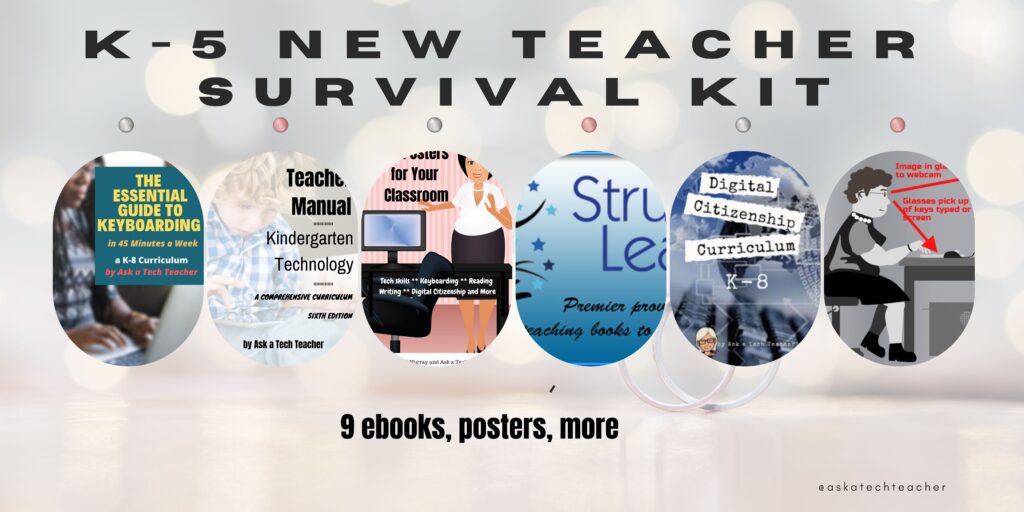
K-5 New Teacher Survival Kit
9 ebooks, 65 digital posters
August 7-August 10
Save 20% with this code:
3xar9wzu
A new teacher survival kit–for professionals new to teaching tech or expanding their pedagogy. It includes K-5 tech curriculum (problem solving, productivity software, critical thinking, share/publish, mouse skills, image editing, Google Earth, Photoshop, web tools, and more), keyboarding and digital citizenship curricula, classroom posters, tech ed tips and tricks, and posters.
You may be the Technology Specialist, the Coordinator for Instructional Technology, IT Coordinator, Technology Facilitator, Curriculum Specialist, Technology Director or the technology teacher for your school—tasked with finding the right computer project for each classroom unit. You have a limited budget, less software, and the drive to do it right no matter the roadblocks.
It’s your job to make sure your school complies with the requirements of Common Core State Standards, ISTE, your state requirements, and/or the IB guidelines that weave technology consistently into the fabric of all units of inquiry as a method of delivering quality education.
How do you reach your goal? The K-5 New Teacher Survival Kit.

Tech Ed Resources–Lesson Plans
I get a lot of questions from readers about what tech ed resources I use in my classroom so I’m taking a few days this summer to review them with you. Some are from members of the Ask a Tech Teacher crew. Others, from tech teachers who work with the same publisher I do. All of them, I’ve found well-suited to the task of scaling and differentiating tech skills for age groups, scaffolding learning year-to-year, taking into account the perspectives and norms of all stakeholders with appropriate metrics to know learning is organic and granular.
Today: Lesson Plans
There are lots of bundles of lesson plans available–by theme, by software, by topic, by standard. Here are a few with links to more detail:
- STEM Lesson Plans
- Coding Lesson Plans
- By Grade Level
- 110 lesson plans–integrate tech into different grades, subjects, by difficulty level, and call out higher-order thinking skills.
- singles–for as low as $.99 each. Genius Hour, Google Apps, Robotics, STEM, Coding, and more.
- Holiday projects–16 lesson plans themed to holidays and keep students in the spirit while learning new tools.
Who needs this
These are for the teacher who knows what they want to teach, but need ideas on how to integrate tech. They are well-suited to classroom teachers as well as tech specialists.

The Homework Loop I Built With Claude Code So My Students Never Wait for Feedback
I love sharing the personal experiences of educators. We all do things differently, in good ways, providing lots of options for diversity among students who don’t get the first or second way we teach a lesson. Brandon Collis, electrical engineer turned private tutor, founder of ClassQuill (https://classquill.com) has ideas on tutoring using AI.

The Homework Loop I Built With Claude Code So My Students Never Wait for Feedback
There’s a specific kind of frustration in tutoring that never shows up in the marketing material: a student sits a test on a Tuesday, gets it back on Thursday, and doesn’t see me again until the following Tuesday. Whatever they got wrong has had a full week to calcify into a bad habit before we even talk about it. Multiply that by twenty students and the gap between “made a mistake” and “someone addressed it” becomes the real bottleneck in how fast anyone improves — not talent, not effort, just timing.
So I built a way to close that gap without it costing me any extra time. I hand Claude Code a student’s test — marked or unmarked, I never touch an answer sheet either way — along with the worked solutions, and it reads both, marks anything I haven’t already marked myself, and tells me exactly what kind of mistake each wrong answer was — a simple slip, the wrong method applied, or a concept they haven’t actually grasped yet. From there it writes a fresh set of practice questions targeting those specific gaps. The real value isn’t faster marking. It’s walking into every session already knowing exactly where a student is weak, with tailored material waiting, without me having spent an hour figuring that out myself.
I built this as a small automated loop out of tools I already had open every day. No custom software, no developer team — just Claude Code pointed at a folder.

How to Teach Middle School Students to Spot Deepfakes

How to Teach Middle School Students to Spot Deepfakes
An artificial intelligence deepfake is a highly realistic image, video or audio that can depict people, places and events. Advances in AI have made these creations increasingly realistic, making it difficult to distinguish between authentic and manipulated content.
Even if middle school students have seen deepfakes, they may not understand the dangers these creations pose. Teachers are uniquely positioned to educate them about algorithmic manipulation and improve their AI media literacy. (more…)

How to Start Your Teaching Career: A Clear Guide to Becoming a Teacher

For career changers, college students nearing graduation, and aspiring teachers drawn to meaningful work, the teaching profession can look like a clear way to make a difference. The hard part is that a career in education brings real tradeoffs alongside the rewards: daily responsibility for students, constant decision-making, and a role that doesn’t end when the school day does. Early choices, such as where to teach, what age group to serve, and how to shape long-term educational career paths, can open doors or create friction. Clarity on teaching motivation makes every next decision easier.
Jenny Wise, idea maker behind Special Home Educator and Ask a Tech Teacher contributor, can help with that:
Map Your Path From Degree to Teacher License
This process helps you go from “I want to teach” to a clear, workable route through education degree requirements, teacher certification requirements, and a realistic grade and subject focus. For general readers, it reduces guesswork and helps you avoid detours that cost time and money. (more…)

Need a New Job? Update Your Resume

- Online sites to build a resume
- What to include in your resume
- Formatting tips
- Additional tips

Digital portfolio sites
Here are some of the best online platforms for creating and hosting a digital resume