Category: Reading

Teacher-Authors: What’s Happening on my Writer’s Blog

A lot of teacher-authors read both Ask a Tech Teacher and my writer’s blog, WordDreams. In this monthly column, I share a popular post from the past month:

National Tell A Story Day
National Tell A Story Day is celebrated every year on April 27th. This day is dedicated to the art of storytelling and encourages people to share their stories and connect with others through the power of narrative. This can involve reading a book, listening to a podcast or audiobook, watching a movie or TV show with a great story, or even just having a conversation with someone and sharing personal stories. (more…)

Great Research Websites for Kids

Please click here for current and updated websites, kid-friendly browsers, citation resources, how-to’s for research, and lesson plans!
Quick, safe spots to send your students for research:
- CoolKidFacts–kid-friendly videos, pictures, info, and quizzes–all 100% suitable for children
- Fact Monster–help with homework and facts
- Google Earth Timelapse–what changes to the planet over time
- Google Trends–what’s trending in searches
- History Channel–great speeches
- How Stuff Works–the gold standard in explaining stuff to kids
- Info Please–events cataloged year-by-year
- National Geographic for Kids
- Ngram Viewer–analyzes all words in all books on Google Books
- TagGalaxy–search using a cloud
- Wild Wordsmyth–picture dictionary for kids
- World Book–requires membership
Citing Resources
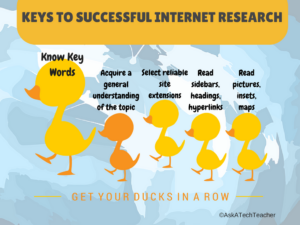
Kids Search Engines

Sure-fire Ways to Teach Vocabulary

Have you ever been around someone who knows exactly the right word when they talk? Don’t you conclude they’re smart? Capable? The one you want in your study group? How about the inverse–an individual struggling with language, maybe picks words that aren’t quite right or can’t come up with one at all. What do you conclude then?
Teachers have always taught ‘vocabulary’ using labels like word study, site words, Dolch, Hi-Frequency words. Common Core considers proper terminology part and parcel to preparing for college and career. They fall into three types:
- Tier 1: Words acquired through every day speech, usually learned in early grades
- Tier 2: Academic words that appear in textbooks, precise words that refine meaning, i.e. ‘sprint’ instead of ‘run’.
- Tier 3: Domain specific words tied to content, included in glossaries, highlighted in textbooks, and considered important to understanding content.

The ‘tier’ you focus on in your teaching depends upon student age and material being taught. Here are five ways technology will make the time you spend on this subject more effective, fun, differentiated, and authentic:
- Context clues
- SpellingCity
- Online graphic dictionaries
- Word clouds
- Vocabulary websites
Before we begin, let’s lay some groundwork. Vocabulary (or word study) isn’t done in a vacuum. You don’t pass out lists and have students memorize words and definitions (you don’t do that, do you?). If you used to, that’s changed with Common Core. Now, you are expected to integrate vocab into learning. Every time students run into a term they don’t get, you need to pause and help them decode it. It may be obvious from context, its parts (roots and affixes), but always–always—pay attention so students know unfamiliar words are not skipped. With Common Core, every nuance is important. It’s about uncovering knowledge.

#WorldReadAloudDay February 4th

World Read Aloud Day is celebrated every year on the first Wednesday of February. It celebrates the pure joy of oral reading with kids of all ages. Created by LitWorld, past years have found over 1 million people in 100 countries joining together to enjoy the power and wonder of reading aloud in groups or individually, at school or home, and discovering what it means to listen to a story told through the voice of another. For many, this is a rare opportunity to hear the passion of a well-told story and fall in love with tales where hearing them reaches listeners on a level nothing else can. Think back to your experiences. You probably sat with an adult, in their lap or curled up in bed. The way they mimicked the voices in the story, built drama, and enthused with you over the story and characters made you want to read more stories like that on your own. This is a favorite activity not just for pre-readers, but accomplished readers because it’s not about reading the book; it’s about experiencing it through the eyes of a storyteller.
Somehow, as lives for both the adults and children have gotten busier, as digital devices have taken over, as parents turned to TVs or iPads to babysit kids while they do something else, we’ve gotten away from this most companionable of activities. World Read Aloud Day is an opportunity to get back to it.

Importance of reading aloud
There is no more powerful way to develop a love of reading than being read to. Hearing pronunciations, decoding words in context, experiencing the development and completion of a well-plotted story as though you were there are reason enough to read aloud but there’s more. Reading in general and reading aloud specifically is positively correlated to literacy and success in school. It builds foundational learning skills, introduces and reinforces vocabulary, and provides a joyful activity that’s mostly free, cooperative, and often collaborative. Did you know reading aloud:

Why Audio Is Becoming as Important as Text in Digital Classrooms

Why Audio Is Becoming as Important as Text in Digital Classrooms
 Photo by rawpixel.com on Freepik
For years, digital classrooms have been built around reading. Lessons are delivered through written instructions, slides, worksheets, and learning management systems that assume students will process information visually. That approach is starting to shift. As AI-supported education tools evolve, teachers are increasingly pairing text with audio to meet students where they are. Voice technologies such as ElevenLabs, which turn written material into clear, natural-sounding speech, are making it easier for educators to add an audio layer to lessons without redesigning their entire curriculum.
This change is not about replacing reading. It’s about recognizing that listening is a core learning skill, and in many cases, an essential bridge to comprehension, confidence, and inclusion in today’s digital classrooms. (more…)

October is Dyslexia Awareness Month

 Recognizing dyslexia
The clearest characteristic is persistent challenges with reading and language processing. Here are quick tips to spot potential signs:
- Reading Difficulties: Slow, labored reading, trouble sounding out words, or skipping/reversing letters (e.g., “b” for “d”).
- Spelling Issues: Frequent misspellings, even of simple or familiar words, or inconsistent spelling of the same word.
- Writing Challenges: Poor handwriting, difficulty organizing thoughts on paper, or avoiding writing tasks.
- Phonological Struggles: Trouble breaking words into sounds, rhyming, or remembering letter sounds.
- Delayed Language Skills: Late talking in childhood or trouble following multi-step verbal instructions.
- Avoidance of Reading: Reluctance to read aloud or engage with books, often due to frustration.
- Family History: Dyslexia often runs in families, so a family history of reading difficulties can be a clue.
These signs vary by age and individual. If noticed, consult a professional (e.g., educator or psychologist) for a formal assessment. Early intervention helps!

Holistic approaches to treating Dyslexia

National Library Week–Resources, Links, Ideas
National Library Week is an annual celebration highlighting the valuable role libraries, librarians, and library workers play in transforming lives and strengthening our communities.
In the mid-1950s, research showed that Americans were spending less on books and more on radios, televisions and musical instruments. Concerned that Americans were reading less, the ALA and the American Book Publishers formed a nonprofit citizens organization called the National Book Committee in 1954. The committee’s goals were ambitious. They ranged from “encouraging people to read in their increasing leisure time” to “improving incomes and health” and “developing strong and happy family life.”
In 1957, the committee developed a plan for National Library Week based on the idea that once people were motivated to read, they would support and use libraries. With the cooperation of ALA and with help from the Advertising Council, the first National Library Week was observed in 1958 with the theme “Wake Up and Read!” The 2023 celebration marks the 65th anniversary of the first event.
Read more here:

#WorldReadAloudDay February 5th

World Read Aloud Day celebrates the pure joy of oral reading with kids of all ages. Created by LitWorld, past years have found over 1 million people in 100 countries joining together to enjoy the power and wonder of reading aloud in groups or individually, at school or home, and discovering what it means to listen to a story told through the voice of another. For many, this is a rare opportunity to hear the passion of a well-told story and fall in love with tales where hearing them reaches listeners on a level nothing else can. Think back to your experiences. You probably sat with an adult, in their lap or curled up in bed. The way they mimicked the voices in the story, built drama, and enthused with you over the story and characters made you want to read more stories like that on your own. This is a favorite activity not just for pre-readers, but beginning and accomplished readers because it’s not about reading the book; it’s about experiencing it through the eyes of a storyteller.
Somehow, as lives for both the adults and children have gotten busier, as digital devices have taken over, as parents turned to TVs or iPads to babysit kids while they do something else, we’ve gotten away from this most companionable of activities. World Read Aloud Day is an opportunity to get back to it.

Importance of reading aloud
There is no more powerful way to develop a love of reading than being read to. Hearing pronunciations, decoding words in context, experiencing the development and completion of a well-plotted story as though you were there are reason enough to read aloud but there’s more. Reading in general and reading aloud specifically is positively correlated to literacy and success in school. It builds foundational learning skills, introduces and reinforces vocabulary, and provides a joyful activity that’s mostly free, cooperative, and often collaborative. Did you know reading aloud:

Tech Tip #139: 9 Reasons to Use Digital Books

In these 169 tech-centric situations, you get an overview of pedagogy—the tech topics most important to your teaching—as well as practical strategies to address most classroom tech situations, how to scaffold these to learning, and where they provide the subtext to daily tech-infused education.
Today’s tip: Using digital books
Category: Problem-solving
As you discuss reading and the technology tools that inspire students in this activity, here’s a poster with nine reasons why students will love digital books:

They’re light-weight, easy to transport, provide links for deeper learning, differentiate for student needs (like zoom to see better or a change of font), allow for the addition of notes that can be erased, and pages never rip. What more could you ask?
Sign up for a new tip each week below or buy the entire 169 Real-world Ways to Put Tech into Your Classroom.
What’s your favorite tech tip in your classroom? Share it in the comments below.

4 Innovative Ways to Enhance Reading Comprehension with AI Tools
I’m excited about this post from the Ask a Tech Teacher crew–AI Tools for reading comprehension. There are so many directions this could go!

4 Innovative Ways to Enhance Reading Comprehension with AI Tools
Struggling to grasp the essence of a dense PDF or wishing students could wrestle more effectively with complex texts? The key may reside in AI-powered reading assistants, a broad category encompassing everything from summarizers to intelligent note-taking platforms.
Let’s explore five innovative strategies that make the most of these AI capabilities, tailored not only to keep pace with rapid technological advancements, but also to foster enhanced educational experiences! (more…)