Category: News

Guiding Students through the Crisis in Ukraine
Here are great ideas for how to address the difficult topic of war in the Ukraine, from Ask a Tech Teacher collaborator, Christian Miraglia, recently retired from teaching after thirty-six years:

24/7
As events unfold in Ukraine, people want to know how the situation might play out. Glancing at the Apple Newsfeed or Twitter for minute-to-minute updates becomes an obsession. For many students, checking on Tik-Tok and Instagram is their source of information. In the classroom, questions on the location of Ukraine, the why of the Russian invasion, and what does the future hold are commonplace. So how does a teacher navigate these conversations?
Essential Skills
As a history teacher, I made it a priority to teach my students how to check the reliability of sources. This became increasingly important over the past decade as social media became the primary source for news. It was not uncommon for a class to start with a comment, “Did you see …?” My response to the student was, “What was the source of information, and how do you know if it is reliable?” A typical year in the class began with learning how to source information using the Reading Like a Historian lessons from the Stanford History Education Group. I also utilized the Civic Reasoning curriculum, which focused on developing critical thinking skills to navigate social media and news. With Ukraine dominating the news cycle, these skills are still essential.
Guiding Principles
Here are some basic principles and resources that can be helpful when addressing the conflict in Ukraine. These tenents are applicable for any sensitive topic or event discussed in class.
- As with any subject when using social media as a tool for study, teachers should review postings as some material may not be suitable for student consumption.
- Use the Civil Discourse materials from Facing History and Ourselves at the beginning of the year so that both you, as a teacher and students, have a framework for approaching complex subjects. Some students may have family or friends serving in the military or have students who may have family from Ukraine.
- Ask the student about the source of information. Check social media feeds and news feeds so students can compare the credibility of sources. Providing students with sentence frames for responding to the question is necessary.
- Ask students why the event is important. Keep in mind that our students may be asking questions based on their fears. For example, students may ask if the events in Ukraine will lead to World War III.
- Make use of geography tools such as Google Maps or the history of Ukraine in maps found on the Washington Post site, as many students do not have a sense of the expansiveness of the world.
- Use proven resources such as Brown University’s Choices Program, which provides teachers with comprehensive lessons on the crisis.
Embrace Conversations
The past five years have created challenges for teachers time and time again with global and national events. Our students are on a similar journey. The description on the Stanford History Education Group’s Civic Reasoning page reads, “Students are confused about how to evaluate online information. We all are.” With each critical piece of news comes a chance to provide our students a platform to voice their concerns and synthesize the information they consume. One might call these “hard conversations,” but embracing these opportunities with the proper resources ultimately builds the foundations of becoming informed citizens.
Bio:
Christian Miraglia is a recently retired 36-year educator and now Educational Technology Consultant at t4edtech where he also blogs at Edtech and Things Related. He can be found on Twitter @T4edtech, Linkedin, and on his YouTube Channel Transformative Edtech.

Here’s a Preview of May
 Here’s a preview of what’s coming up on Ask a Tech Teacher in May:
- Teacher Appreciation Gifts (for the geek)
- 12 Tech Tasks to End the School Year
- 13 Bits of Wisdom I learned from my Computer (humor)
- Find Public Domain Images
- College or Career? Check out These Articles
- Memorial Day Websites

Happy July 4th (and Happy Canada Day)
 It’s America’s birthday and I’m celebrating. My Army Sergeant son is in Japan–Okinawa. My Navy LT CDR daughter’s in the DC area. I thank both of them and all those soldiers who fought for America’s uncertain future so long ago.
God be with all of us.
[youtube http://www.youtube.com/watch?v=MDkP2WaEYFE&w=560&h=349] [youtube http://www.youtube.com/watch?v=RJvcJczKRB0&w=425&h=349] [youtube http://www.youtube.com/watch?v=BUDs-8SxfUE&w=425&h=349] [youtube http://www.youtube.com/watch?v=Q65KZIqay4E&w=425&h=349]I want to include all my efriends from Canada in the celebrations though I’m a few days late for Canada Day:

Fake News or Fact? How do you tell?
 Keeping up with national and international events was a lot easier when all the news came from one of three major TV news outlets and a few newspapers like The New York Times. Now, there are dozens of channels, hundreds of newspapers, thousands of bloggers, and tens of thousands of social media journalists — all trying to get your attention with the latest apocalyptic news flash. Stories based on gossip as much as fact used to be designated Yellow Journalism. Now, in what has been called a post-truth society (defined by Oxford Dictionary as “relating to or denoting circumstances in which objective facts are less influential in shaping public opinion than appeals to emotion and personal belief”), it is the reader’s responsibility to differentiate between fact and fake news.
What is fake news?
Here are two definitions of fake news:
“false stories that appear to be news, spread on the Internet or using other media, usually created to influence political views or as a joke” — Cambridge English Dictionary
“a type of yellow journalism or propaganda that consists of deliberate disinformation or hoaxes spread via traditional print and broadcast news media or online social media.” — Wikipedia
In layspeak:
“Fake news is information reported as fact without reliable evidence, trustworthy sources, and/or proper vetting” — Jacqui Murray
Sounds like something every thinking person would want to avoid but a recent Stanford Graduate School of Education report shows that 80-90% of high school students had difficulty judging the credibility of news. So how do we teach students to know the difference?

Happy Fourth of July!
It’s America’s birthday and I’m celebrating. I have an Army son heading off overseas and a Navy daughter doing her thing stateside. I’m toasting both of them today and all of America’s warriors, God be with you.
May–Military Appreciation Month–God Bless Our Soldiers
As many of you know, I have a daughter in the Navy and a son in the Army. I love them both and live every day worried. But through it all, I appreciate what they are doing to make America what so many need it to be.
I love America. I love our military. I love my daughter and son.
You don’t have to watch all of these. I got carried away on YouTube. I just couldn’t pick a favorite…
[youtube https://www.youtube.com/watch?v=9qqPqHGX7q4]
[youtube https://www.youtube.com/watch?v=2UG5YoHcCAY]
[youtube https://www.youtube.com/watch?v=IwoXmXA8BvY]
[youtube https://www.youtube.com/watch?v=ahHPRFJinZM]
[youtube https://www.youtube.com/watch?v=m3MX2ha8QAQ]
And the ever-favorite (17 million views):

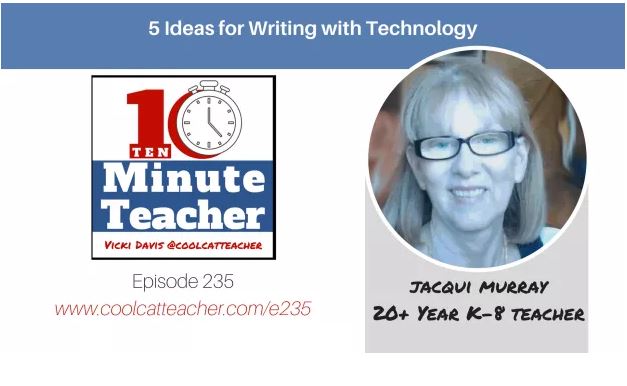
Technology and Writing: A Conversation with Vicki Davis
Vicki Davis is a teacher, author, podcaster, tweeter, blogger, international presenter, and so much more. I admire her podcasts and posts so was honored when she invited me to chat with her on her podcast, the 10-Minute Teacher. The topic is one dear to my heart: How to use technology to teach writing in creative ways.
Click the image below to access her post where you can listen to the podcast or read the transcript–whichever works better for you. Or scroll down a bit more and you’ll find the podcast embedded:
Vicki’s bio

Mysimpleshow Keeps Getting Better
mysimpleshow, digital tool of choice in the explainer video market, has done it again. They’ve come out with a great change that will make their explainer videos even easier to use in a classroom. mysimpleshow “Classroom” offers the full variety of design functions with a focus on collaborative learning: Up to 50 students can create joint video projects that promote their creativity and teamwork. Previously, a price tag was attached but the creators of simpleshow have decided to make the “Classroom” free of charge, in addition to the free basic account.
Here’s an explainer video about the mysimpleshow Classroom:

About simpleshow: simpleshow is the market leader for professional explainer video production and so far has produced several thousand clips in more than 50 languages worldwide. With offices in Luxembourg, Berlin, Stuttgart, London, Zurich, Miami, Singapore, Hong Kong, Kuala Lumpur and Tokyo, more than 150 employees serve customers around the globe. simpleshows explain complex topics in short, entertaining, and easy-to-understand videos; and its methodology is trusted by major blue-chip corporations worldwide. Today, the company offers a variety of formats, from simple online videos to innovative and interactive online courses, and its online video maker mysimpleshow.

Happy Thanksgiving Week to All!
 I’m taking next week off. I’ll be preparing for my daughter’s holiday visit from her home in DC and my son who’s visiting from virtually from Okinawa Japan. I am so excited to see both of them!
I’ll be back November 27th. Any emergencies–drop me a line at askatechteacher@gmail.com.
Jacqui Murray has been teaching K-18 technology for 15 years. She is the editor/author of over a hundred tech ed resources including a K-8 technology curriculum, K-8 keyboard curriculum, K-8 Digital Citizenship curriculum. She is an adjunct professor in tech ed, CSG Master Teacher, webmaster for four blogs, an Amazon Vine Voice book reviewer, CAEP reviewer, CSTA presentation reviewer, freelance journalist on tech ed topics, and a weekly contributor to TeachHUB. You can find her resources at Structured Learning.

How Magnolia ISD ‘leveled the playing field’ for students in math
If you’re evaluating math programs at your school, a good option to consider is ORIGO Education’s Stepping Stones. Here’s one educator’s story about how Stepping Stones made a big difference with his students’ math skills:
 How Magnolia ISD has ‘leveled the playing field’ for students in math
by Dennis Pierce
Like many U.S. school systems, the Magnolia Independent School District in Texas serves a diverse student population. More than a third of its students come from low-income families, and one out of every eight students is an English language learner. Yet, the district has seen consistent and remarkable success in math achievement across all of its elementary schools since it began using Stepping Stones, a prekindergarten through sixth grade comprehensive math program from ORIGO Education.